
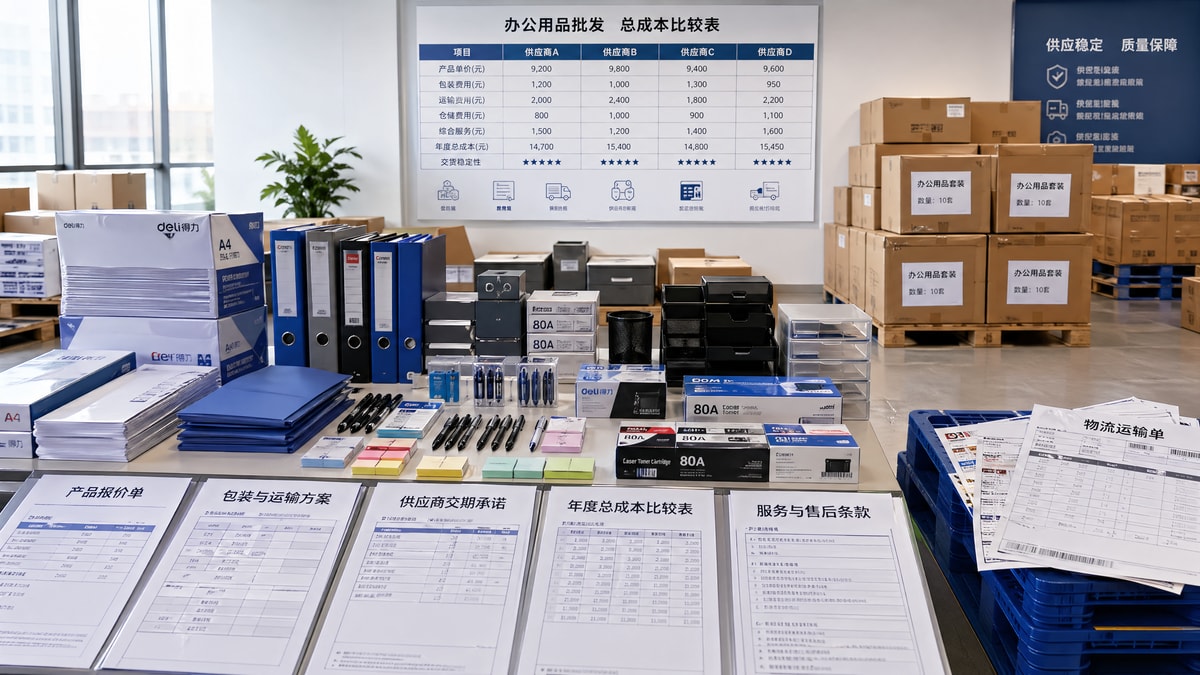
Choosing the right office supplies wholesale vendor is not just about unit price. For procurement professionals, total cost includes shipping, minimum order quantities, payment terms, product consistency, and after-sales service. This guide explains how to compare suppliers from a full-cost perspective, helping buyers reduce hidden expenses, improve sourcing efficiency, and make smarter purchasing decisions in a competitive market.
Why total cost matters in different purchasing scenarios
In office supplies wholesale, the lowest quoted price can easily become the highest real cost once freight, replenishment delays, damaged goods, and administrative workload are included. For procurement teams, this issue becomes more visible when purchase frequency exceeds 2 to 4 orders per month or when SKU counts rise above 50 to 100 items. A vendor that looks cheap on paper may create extra work across receiving, accounting, and inventory control.
Different business scenarios also change what “best value” means. A distributor replenishing fast-moving stationery may prioritize fill rate and carton efficiency. A multi-branch company may focus on delivery consistency across locations. A cross-border seller sourcing office accessories may care more about export packing, labeling, and lead time stability. Comparing office supplies wholesale vendors without defining the use scenario often leads to inaccurate decisions.
For readers following sourcing trends through TrendNest Daily, this full-cost view is especially relevant because office supplies sit within broader everyday goods and consumer product supply chains. The same sourcing logic used in small commodities applies here: evaluate landed cost, operational friction, and supplier responsiveness together, not as separate issues.
Common cost elements buyers often underestimate
- Freight cost by carton, pallet, or mixed shipment, especially when order density is low.
- Minimum order quantity pressure that ties up cash for 30 to 90 days.
- Quality variation that increases return handling, claim processing, and urgent replacement orders.
- Administrative costs from unclear invoices, missing barcodes, or inconsistent packing lists.
- Stockout impact when lead times shift from a normal 7 to 15 days to 20 to 45 days.
When buyers compare office supplies wholesale vendors using a total-cost model, they can rank suppliers based on actual business impact. This is more practical than selecting by catalog price alone, especially in categories such as paper products, filing supplies, pens, desk organizers, and printer consumable accessories where replenishment cycles are frequent and price gaps can be narrow.
Scenario-based comparison: what matters most in real procurement situations
To compare office supplies wholesale options effectively, buyers should first identify the operating scenario. The same supplier may be ideal for one use case and weak for another. The table below outlines three common purchasing scenarios and the cost factors that deserve the most weight in each case.
This comparison shows why office supplies wholesale sourcing should begin with business context. A local office manager may save more from a vendor with lower MOQ and faster replenishment, while a reseller may gain more from better carton utilization and fewer shipping losses. In practice, scenario fit often affects 10% to 20% of total cost, even when unit prices differ by only a few percentage points.
Scenario 1: single-office recurring purchasing
In a single-office environment, the procurement objective is usually simple: keep desks, meeting rooms, and print areas supplied without overstocking. Here, a vendor offering mixed-carton orders, lower minimums, and a lead time of under 10 business days may outperform a cheaper supplier that requires bulk case purchases. Storage space is often limited, and overbuying basic office products creates hidden warehousing costs.
Buyers in this scenario should monitor order frequency, emergency replenishment rate, and unusable stock levels. If urgent purchases happen more than once per month, the real issue may not be employee demand but poor vendor fit. Office supplies wholesale suppliers that can provide better order visibility and more flexible replenishment cycles can lower both stockout risk and purchasing labor.
Another key issue is invoice and item accuracy. For offices buying 30 to 80 recurring SKUs, even small errors on quantities or item codes create extra reconciliation time. A vendor with clear SKU mapping, barcode support, and consistent case labeling can reduce processing work for both procurement and finance teams.
Scenario 2: multi-site or branch distribution
When office supplies must be delivered to several locations, supplier performance becomes more important than simple price. A missed shipment to one branch can trigger local spot buying at a premium, and these unplanned purchases quickly distort budget control. In this scenario, procurement teams should look at on-time delivery performance over at least 3 shipping cycles rather than relying on one sample order.
Service consistency also matters. Vendors should be evaluated on shortage communication, backorder handling, and replacement speed. If a supplier takes 48 to 72 hours to confirm a shortage, internal teams lose time adjusting allocations. Office supplies wholesale partners that communicate issues before dispatch help buyers protect service continuity across branches.
Packaging standards are another cost driver. Uniform outer cartons, branch-level packing instructions, and item labels reduce receiving errors. In high-volume operations, a 1% to 3% picking error rate can create repeated downstream costs that exceed the savings from a lower unit quote.
Scenario 3: export, resale, or cross-border sourcing
For importers, traders, and cross-border sellers, the office supplies wholesale decision extends beyond domestic purchasing logic. Carton dimensions, gross weight, inner pack structure, and shipping marks directly affect freight cost and customs handling. A supplier with efficient export packaging may lower landed cost more than a supplier with a slightly lower ex-works price.
Lead time stability is critical here. A production cycle of 20 to 35 days may be manageable if it is consistent, but highly variable output creates booking and sales planning problems. Buyers should ask for typical production windows, peak-season changes, and reorder timing recommendations, especially for seasonal back-to-school or promotional demand.
Documentation capability also affects total cost. While not every office product category requires the same paperwork, procurement teams still benefit from suppliers that can provide packing lists, carton details, and product specifications in a clear, repeatable format. Better documentation reduces communication rounds and helps avoid shipment delays.
How to build a full-cost vendor comparison model
A practical office supplies wholesale comparison model should assign weighted scores to cost and service factors. Procurement teams can start with 5 to 7 dimensions and adjust percentages based on scenario. This method creates a clearer basis for approval discussions and supplier reviews than relying on a price sheet alone.
Suggested evaluation dimensions
- Unit price by core SKU group, such as writing instruments, paper items, desk supplies, and filing products.
- Freight and delivery terms, including carton count, shipment threshold, and regional surcharge.
- MOQ and inventory pressure, measured by expected stock holding in weeks or months.
- Lead time stability across at least 2 to 3 order cycles.
- Quality consistency, claims handling, and replacement speed.
- Payment terms and credit flexibility, especially for growing accounts.
Before selecting a supplier, buyers should compare not only “quoted value” but “usable value.” If one vendor offers net 30 terms, lower mixed-order MOQ, and fewer shortages, that supplier may generate better cash flow and lower process cost over a 90-day period.
The following scoring example can be adapted for office supplies wholesale decisions in both domestic and export-oriented purchasing.
This type of matrix gives procurement professionals a balanced way to compare office supplies wholesale vendors. The exact weights can shift by scenario, but using a model like this helps teams document trade-offs and avoid overvaluing headline discounts.
Common mistakes when comparing office supplies wholesale suppliers
One common mistake is comparing vendor A’s price for a small trial order against vendor B’s volume price without normalizing pack size, payment terms, and freight basis. A fair comparison should align product grade, unit of measure, and delivery condition. Even in standard stationery categories, small differences in pack configuration can change the usable cost per employee or per branch.
Another mistake is ignoring reorder behavior. If a supplier offers low opening prices but cannot support monthly replenishment, buyers may end up using multiple secondary vendors. Managing 3 vendors instead of 1 can increase administrative time, invoice complexity, and quality variation. For many procurement teams, process efficiency is a real cost center.
Warning signs to review before approval
- Large price changes within 30 days without a clear raw material or freight explanation.
- MOQs that force 3 to 6 months of stock for routine items.
- No clear process for shortages, claims, or damaged-delivery reporting.
- Inconsistent sample quality between first and repeat orders.
- Slow response on packing details, barcode data, or delivery schedules.
Buyers should also avoid treating all categories the same. In office supplies wholesale, paper-based items, plastic organizers, writing tools, and desktop accessories can have different lead-time and damage-risk profiles. Segmenting high-volume SKUs from low-volume or seasonal products often leads to a smarter vendor mix.
Practical next steps for procurement teams
A useful first step is to define your top 20 to 30 office supplies SKUs by annual spend, order frequency, and service sensitivity. Then ask each vendor to quote against the same list with identical commercial assumptions. This simple discipline makes office supplies wholesale comparisons far more reliable and exposes hidden differences in carton rules, lead times, and service scope.
Next, run a 60 to 90 day pilot where possible. Measure fill rate, shipment accuracy, response time, and cost exceptions, not just invoice totals. Procurement decisions improve when vendors are tested in real operating conditions instead of judged only by onboarding promises.
Finally, document scenario-specific priorities. If your organization is scaling branch coverage, weight logistics and service more heavily. If your business is export-oriented, focus on packing efficiency, documentation, and production stability. A scenario-led approach helps buyers choose office supplies wholesale partners that fit actual operations rather than generic assumptions.
Why choose us
TrendNest Daily helps procurement professionals, buyers, distributors, and sourcing teams understand supplier selection through a practical industry lens. Our coverage connects office supplies wholesale decisions with broader small-commodity sourcing trends, supply chain changes, product movement, and cross-border trade realities.
If you are reviewing office supplies wholesale options, contact us to discuss sourcing parameters, product selection logic, delivery cycle expectations, sample support, packaging considerations, and quotation comparison methods. We can help you structure your vendor review around real business scenarios so your next purchasing decision is based on total cost, not just the initial price tag.
Industry Global
Related News
- 00
0000-00
How to Shortlist a Home Decor Manufacturer for Export Projects - 00
0000-00
Fragrance Wholesale in 2026: What Buyers Need to Know Before Importing - 00
0000-00
How to Choose an Aroma Diffuser for Home Based on Room Size - 00
0000-00
How to Pick Decorative Items for Office Without Making It Look Cluttered - 00
0000-00
Home Styling Tips That Make Small Spaces Feel More Put Together
Weekly Insights
Stay ahead with our curated technology reports delivered every Monday.
Related News
 How to Shortlist a Home Decor Manufacturer for Export ProjectsHome Decor manufacturer guide: learn how to shortlist export-ready partners for Home Fragrance diffuser, Decorative Items for office, and custom gifts for corporate with less sourcing risk.
 Fragrance Wholesale in 2026: What Buyers Need to Know Before ImportingFragrance wholesale in 2026: learn how to evaluate Home Fragrance diffuser, Aroma Diffuser for home, Scented Candles custom, and Essential Oils for relaxation before importing.
 How to Choose an Aroma Diffuser for Home Based on Room SizeAroma Diffuser for home guide by room size: compare Home Fragrance diffuser types, Reed Diffuser benefits, Essential Oil Diffuser price, and Aromatherapy Oils for sleep to choose the best fit.
 How to Pick Decorative Items for Office Without Making It Look ClutteredDecorative Items for office made simple: discover Home Styling tips, smart office supplies bulk order ideas, and sourcing advice from a Home Decor manufacturer for a clean, professional workspace.