Why do some Reed Diffuser refill formulas lose their scent and appearance much faster than others? For quality control and safety teams, fading is more than a performance issue—it can signal instability, ingredient imbalance, packaging incompatibility, or storage risks. Understanding the factors behind formula fade helps professionals improve consistency, reduce complaints, and strengthen product reliability across competitive consumer goods markets.
In the consumer goods sector, especially across personal care, home fragrance, and export-oriented small commodity categories, a fading Reed Diffuser refill can quickly become a quality claim, a retailer return issue, or a brand reputation problem. Buyers may describe the issue as weak throw after 2 to 3 weeks, yellowing liquid, uneven evaporation, or visible sediment inside the bottle.
For QC and safety managers, the root cause is rarely a single factor. Formula fade usually results from an interaction between raw material quality, solvent balance, fragrance composition, reed performance, container compatibility, and storage conditions during a 30-day to 180-day product lifecycle. A structured review process is essential when evaluating any Reed Diffuser refill program.
Key reasons a Reed Diffuser refill formula fades too quickly
The first cause is fragrance volatility mismatch. A Reed Diffuser refill often combines top, middle, and base notes with solvents that control capillary movement. If the blend contains too many highly volatile materials and too little anchoring content, the scent may smell strong in the first 3 to 7 days but weaken sharply by week 2 or week 3. This creates an uneven consumer experience and makes performance appear unstable even when fill volume remains normal.
A second cause is solvent imbalance. In many refill systems, solvent choice affects evaporation rate, scent diffusion, clarity, and safety profile. If the solvent evaporates too fast under 25°C to 32°C retail or warehouse temperatures, the formula may lose both volume and olfactory strength. If it evaporates too slowly, consumers may complain that the diffuser looks full but performs poorly. The wrong solvent ratio can also increase haze, discoloration, or fragrance separation.
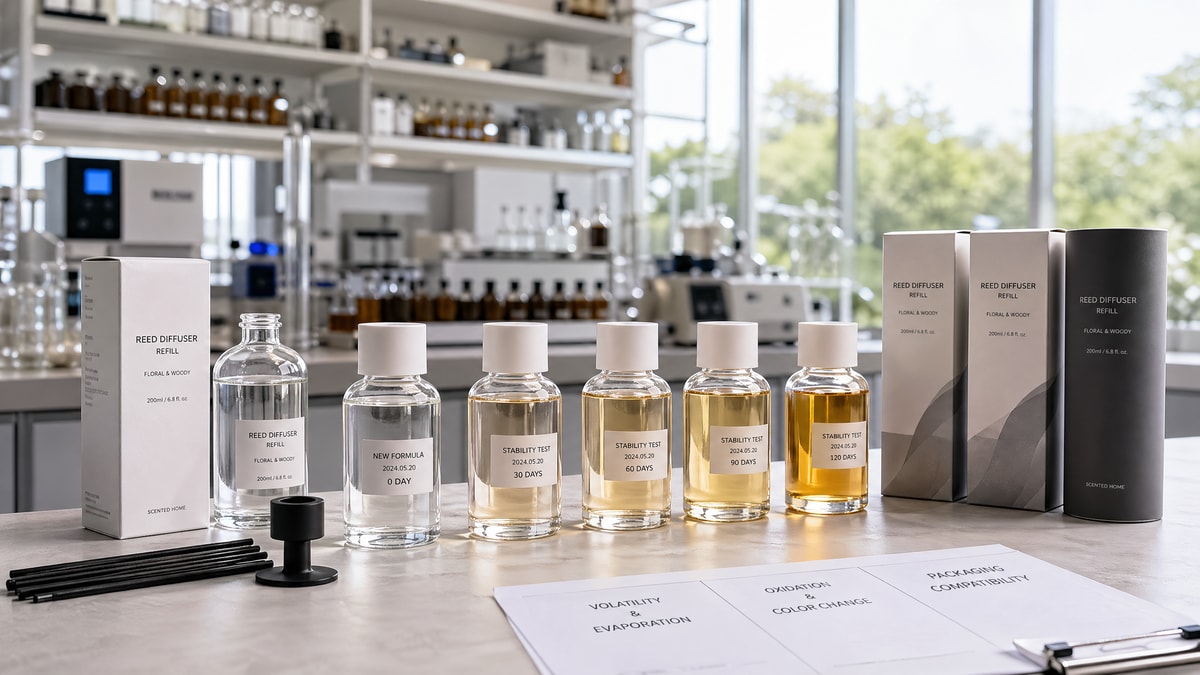
A third issue involves oxidation and light exposure. Some fragrance components are sensitive to oxygen, UV, and metal contamination from pumps, caps, or filling lines. Even small levels of exposure can trigger color change from clear to pale yellow or amber within 4 to 8 weeks. In quality terms, visual fade and scent fade are often linked, because oxidative degradation changes the aromatic profile as well as the liquid appearance.
Another frequent reason is poor compatibility with reeds and packaging. A Reed Diffuser refill may test well in the lab but behave differently in market packs. Reed diameter, pore structure, neck opening, bottle wall coating, and closure liner materials all influence evaporation and migration. When one element changes in a multi-supplier supply chain, product performance can shift by 15% to 30% without any formal formula change.
Common fade triggers seen by QC teams
- High top-note concentration with insufficient fixative support for a 30-day to 60-day use cycle.
- Unstable dye or botanical extract systems that react under heat, light, or trace impurities.
- Fill-line contamination, including water ingress above 0.2% to 0.5%, which may reduce clarity.
- Packaging substitutions without revalidation, especially new bottle coatings or cap liners.
- Storage above recommended conditions, such as prolonged exposure above 30°C or direct sunlight.
These triggers matter because fade is not only a sensory issue. It also affects repeat purchase, online reviews, and export compliance checks where visual consistency and labeling accuracy are part of buyer acceptance criteria. For B2B teams sourcing refill products across different factories, controlling these variables is critical.
How raw materials and formulation design influence scent retention
A stable Reed Diffuser refill starts with material selection. Fragrance oils vary in flash behavior, oxidation sensitivity, and interaction with solvents. Two formulas can carry the same fragrance description on paper yet perform very differently in real use. One may maintain acceptable throw for 45 to 60 days, while another drops below target intensity after only 14 to 21 days because its core aromatic materials are less stable.
Formulators also need to balance diffusion and longevity. A fast-moving system may create stronger first impressions on shelf trials, but QC teams should assess the full performance curve, not only day-1 intensity. In many categories, a more balanced release pattern is preferable, where scent strength remains within an acceptable range for at least 70% of the claimed use period.
Color systems should be reviewed with equal rigor. Dyes, natural extracts, and decorative additives may create visual appeal, but they can accelerate fade if they are not chemically stable in the selected solvent blend. Even a low loading level can cause haze, precipitation, or bottle staining over a 6-week to 12-week observation window.
Formulation checkpoints for a longer-lasting Reed Diffuser refill
Before approving a formula, teams should define measurable targets for scent retention, evaporation rate, color stability, and clarity. These targets are often more useful than subjective comments like “strong” or “premium.” A structured specification helps compare pilot batches from different suppliers and reduces approval risk.
The table shows why a Reed Diffuser refill cannot be judged by fragrance choice alone. A formula that smells attractive at filling may still fail after transit, warehousing, or consumer use if appearance and evaporation are not validated together. For sourcing teams, this is a strong reason to request pilot stability records before scaling orders.
Practical review steps
- Screen fragrance and solvent combinations under both ambient and elevated temperature conditions.
- Check color, odor shift, and clarity at week 1, week 4, and week 8.
- Re-test after packaging substitution, especially if bottles, reeds, or closures come from new vendors.
Packaging, reeds, and storage conditions that accelerate fade
Even a well-designed Reed Diffuser refill may fail if packaging and storage conditions are not controlled. Glass quality, internal coatings, neck dimensions, cap seal integrity, and reed absorbency can each change evaporation behavior. In practice, a refill system tested in one 100 mL bottle may not perform the same way in a different 120 mL decorative pack, even if the liquid formula is identical.
Reed selection is especially important. Natural reeds and fiber reeds differ in pore uniformity, pickup speed, and resistance to clogging. A reed set that is too porous may consume fragrance too quickly in the first 10 to 15 days, while a dense or poorly cut reed may create weak throw and consumer dissatisfaction. QC teams should treat reed specifications as a controlled component, not as a secondary accessory.
Storage and transport can amplify these problems. During export logistics, refill products may sit in containers or regional warehouses for 4 to 10 weeks. Exposure to 35°C or repeated thermal cycling may accelerate oxidation, alter scent perception, and increase internal pressure on closures. If light-sensitive formulas are packed in clear bottles without protection, visible yellowing becomes more likely before the product even reaches retail shelves.
Packaging risk indicators for quality and safety teams
The following comparison helps identify which packaging factors deserve closer validation when fade complaints appear across different production lots or markets.
This table highlights a practical point for multi-market consumer goods businesses: fade risk rises when packaging sourcing is fragmented. If the refill liquid comes from one supplier, reeds from another, and decorative bottles from a third, change control must cover all three inputs. Otherwise, complaint analysis becomes slow and inconclusive.
Storage guidance worth standardizing
- Store sealed refill units in a cool, dry area, ideally around 15°C to 25°C where practical.
- Avoid direct sunlight and prolonged shelf exposure near windows or heat sources.
- Use first-in, first-out inventory rotation, especially when lead times exceed 60 days.
- Document any market-specific transport risks, including summer container shipments and last-mile delays.
Testing methods and control points for preventing fade complaints
For QC and safety departments, the best defense against fading Reed Diffuser refill issues is a repeatable test protocol. Sensory review alone is not enough. Products should be monitored across multiple checkpoints, including fill appearance, odor stability, evaporation pattern, packaging compatibility, and transit resilience. These tests do not need to be overly complex, but they should reflect actual commercial conditions.
A practical program often includes accelerated testing and real-time observation. Accelerated testing can reveal likely oxidation, color shift, and seal loss trends within 2 to 4 weeks. Real-time tests over 6 to 12 weeks provide a more accurate picture of consumer performance. Combining both methods allows teams to flag high-risk formulas before bulk rollout, especially when new fragrance concepts or new export markets are involved.
Complaint prevention also depends on batch-to-batch control. If raw material sourcing changes, or if one fragrance component moves to a different supplier, teams should review whether odor strength, color, or evaporation behavior shifts outside the accepted range. Small variation at incoming inspection can become a major issue after distribution.
Core control points in a Reed Diffuser refill approval workflow
- Incoming material check: confirm odor consistency, color, clarity, and packaging conformity for each batch.
- Compatibility test: evaluate formula with the actual bottle, closure, and reed set intended for sale.
- Stability review: inspect samples at defined intervals such as day 7, day 30, and day 60.
- Transit simulation: assess leakage, odor loss, and appearance after vibration and temperature exposure.
- Release decision: compare results against written acceptance limits before final shipment approval.
These five steps help convert subjective fragrance evaluation into a controlled B2B quality process. For contract manufacturing and private-label projects, they are especially useful because they create a documented basis for supplier alignment and claim handling. A Reed Diffuser refill that passes these checks is far less likely to trigger returns tied to fading, separation, or weak room scent.
Warning signs that should trigger deeper investigation
Teams should escalate review if they see rapid odor flattening within the first 14 days, visible yellowing before 30 days, unusual liquid level loss in sealed stock, or inconsistent performance between identical production lots. Any one of these signs may point to instability, but multiple signs together usually indicate a broader control gap involving formula, packaging, or storage.
In many consumer goods operations, the most effective correction is not a full reformulation but tighter specification discipline. Setting clear acceptance ranges for appearance, evaporation, and scent retention can reduce variability while maintaining the intended fragrance identity.
Supplier selection, FAQ, and action steps for more reliable refill performance
When sourcing a Reed Diffuser refill for branded retail, OEM, or export channels, buyers should look beyond fragrance profile and target cost. Supplier capability should include documented stability practices, change control procedures, compatibility awareness, and realistic shelf-life support. A lower unit price may become expensive if complaint rates rise after market launch.
For quality and safety managers, supplier review should include at least 4 dimensions: raw material consistency, packaging coordination, test discipline, and storage guidance. It is also worth asking how the supplier manages reformulation when one fragrance ingredient becomes unavailable. Uncontrolled substitutions are a common hidden cause of fade variation in fast-moving consumer goods supply chains.
Below are several practical questions that often come up during procurement, product review, and complaint prevention for Reed Diffuser refill programs.
How long should a stable Reed Diffuser refill maintain acceptable performance?
This depends on bottle size, reed count, formula design, and ambient conditions, but many commercial products target 30 to 60 days of acceptable scent diffusion. QC teams should define “acceptable” in advance, because consumer expectation differs between premium gift packs and value-oriented everyday home fragrance lines.
What purchasing documents are most useful before approving a supplier?
Useful documents include product specification sheets, basic stability observations, packaging compatibility notes, storage recommendations, and change notification procedures. If the project is export-focused, teams should also confirm transport assumptions and any market-specific labeling or safety review steps tied to the refill format.
Can packaging alone cause scent fade even when the formula is acceptable?
Yes. A poor seal, unsuitable reed structure, or reactive decorative finish can materially change evaporation and odor quality. This is why finished-pack validation is more reliable than liquid-only approval. In practice, many fade complaints are mixed-origin problems rather than purely formulation failures.
Final decision checklist
- Confirm the Reed Diffuser refill has passed both accelerated and real-time observation.
- Validate the actual bottle, closure, and reed combination, not substitute lab packaging.
- Review storage and shipping conditions for markets with high heat or long transit cycles.
- Require documented change control for fragrance, solvent, dye, and packaging vendors.
Faster fading in a Reed Diffuser refill is usually a controllable issue when teams evaluate formula design, material stability, packaging compatibility, and logistics as one system. For manufacturers, buyers, and brand owners operating in competitive consumer goods markets, stronger validation reduces complaints, supports repeat orders, and protects product credibility. To review sourcing risks, compare refill options, or discuss a more stable product strategy, contact us to get a tailored solution and learn more about reliable home fragrance supply approaches.
Industry Global
Related News
- 00
0000-00
How to Shortlist a Home Decor Manufacturer for Export Projects - 00
0000-00
Fragrance Wholesale in 2026: What Buyers Need to Know Before Importing - 00
0000-00
How to Choose an Aroma Diffuser for Home Based on Room Size - 00
0000-00
How to Pick Decorative Items for Office Without Making It Look Cluttered - 00
0000-00
Home Styling Tips That Make Small Spaces Feel More Put Together
Weekly Insights
Stay ahead with our curated technology reports delivered every Monday.
Related News
 How to Shortlist a Home Decor Manufacturer for Export ProjectsHome Decor manufacturer guide: learn how to shortlist export-ready partners for Home Fragrance diffuser, Decorative Items for office, and custom gifts for corporate with less sourcing risk.
 Fragrance Wholesale in 2026: What Buyers Need to Know Before ImportingFragrance wholesale in 2026: learn how to evaluate Home Fragrance diffuser, Aroma Diffuser for home, Scented Candles custom, and Essential Oils for relaxation before importing.
 How to Choose an Aroma Diffuser for Home Based on Room SizeAroma Diffuser for home guide by room size: compare Home Fragrance diffuser types, Reed Diffuser benefits, Essential Oil Diffuser price, and Aromatherapy Oils for sleep to choose the best fit.
 How to Pick Decorative Items for Office Without Making It Look ClutteredDecorative Items for office made simple: discover Home Styling tips, smart office supplies bulk order ideas, and sourcing advice from a Home Decor manufacturer for a clean, professional workspace.