When evaluating an Essential Oil Diffuser for large rooms, coverage claims alone rarely tell the full story. For technical assessors and product decision-makers, real-world performance depends on airflow design, mist output stability, tank capacity, and room conditions—not just the square-foot number on the box. This article highlights what those claims often miss and how to assess large-room diffuser performance more accurately.
In practice, a diffuser rated for a large area may perform well in one test room and poorly in another. Ceiling height, HVAC airflow, humidity, open-plan layouts, and even furniture placement can change how scent disperses. That is why technical evaluation should move beyond marketing labels and focus on measurable operating behavior under realistic conditions.
For buyers, product managers, sourcing teams, and technical reviewers, the key question is not simply whether a unit can run in a large room. The better question is whether it can deliver consistent aromatic performance across that space without excessive oil use, unstable misting, frequent refilling, or unacceptable noise. That distinction matters in both consumer product positioning and commercial procurement.
Why coverage claims are often too simple for technical evaluation
Most coverage claims are based on controlled or loosely defined test conditions. A brand may state that a diffuser covers 500, 800, or even 1,000 square feet, but the claim often lacks important context. It may not specify room shape, ceiling height, ventilation intensity, scent concentration threshold, or runtime conditions. Without those details, the number is more of a directional marketing indicator than a technical performance metric.
This becomes especially important in large rooms because scent distribution is not uniform. An ultrasonic diffuser may create visible mist near the unit while producing weak scent perception at the perimeter. In a sealed test chamber, that may still qualify as “coverage.” In an actual living room, showroom, studio, lobby, or meeting space, users experience performance very differently. A technical assessor should therefore separate nominal reach from effective and usable coverage.
Another issue is that “coverage” may refer to intermittent scent detection rather than stable diffusion. For product benchmarking, it is more useful to examine whether the diffuser maintains a predictable aromatic presence over time. A unit that briefly fills a room after startup but fades sharply within 20 minutes is not equivalent to one that sustains balanced output for several hours.
What actually determines large-room diffuser performance
The first major factor is mist output stability. A diffuser designed for larger spaces should maintain a consistent atomization rate rather than front-loading output at the beginning of the cycle. Technical teams should observe whether mist density changes as water level drops, whether output weakens during long runs, and whether pulse modes create meaningful scent continuity rather than obvious dead intervals.
The second factor is airflow and dispersion design. Two diffusers with similar tank sizes and wattage can perform very differently if one has better internal airflow management. Outlet angle, fan-assisted movement, droplet size, and casing geometry all influence how scent travels. In large rooms, a diffuser that sends mist upward into stagnant air may underperform compared with a design that promotes broader lateral distribution.
Third is tank capacity versus output rate. Large-room claims are not credible if the required output drains the tank too quickly. A product may technically scent a large room at maximum mode, but if it requires refilling every two to three hours, its practical value drops. For technical evaluation, runtime at effective large-room settings is often more revealing than peak output alone.
How room conditions distort “large room” results
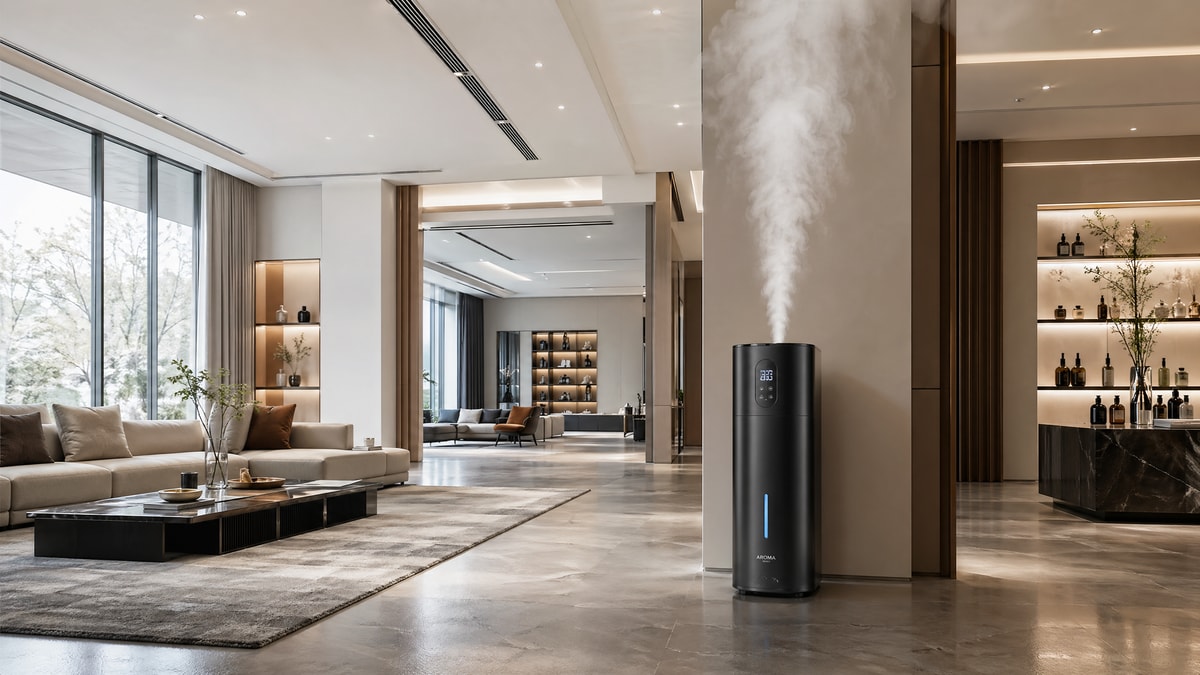
A large room is not a standardized environment. An 800-square-foot open-plan room with strong air conditioning behaves very differently from an 800-square-foot enclosed lounge with limited airflow. HVAC systems can dilute scent rapidly, while open doorways and connected spaces can pull aroma away from the target zone. This is why coverage numbers should always be interpreted as conditional rather than absolute.
Ceiling height is another commonly overlooked variable. Many coverage claims rely on floor-area numbers, but scent disperses in volume, not just across a flat surface. A room with a high ceiling may require more sustained output to achieve noticeable aroma at occupant level. For technical assessment, cubic volume is often more informative than square footage alone, especially in hospitality or retail environments.
Humidity and temperature also affect diffusion behavior. Ultrasonic units rely on water-based mist generation, and ambient conditions can influence evaporation and scent perception. In drier environments, visible mist may disperse differently than in humid rooms. Technical reviewers should therefore avoid overgeneralizing from single-condition tests and instead document the environmental context in which performance was observed.
What to test instead of trusting the number on the box
For a more accurate evaluation of an Essential Oil Diffuser for large rooms, start with a structured test matrix. Measure startup scent detection time, perceived scent strength at multiple distances, runtime at different modes, refill frequency, and output consistency over time. If possible, test in more than one room type, including at least one ventilated space and one relatively closed environment.
Distance-based assessment is particularly useful. Instead of asking whether the room is “covered,” assess scent presence at 1 meter, mid-room, and perimeter positions after 10, 30, and 60 minutes. This creates a more realistic performance map and reveals whether the diffuser delivers even distribution or only localized intensity. For product comparison, such testing is far more useful than relying on a single manufacturer coverage figure.
Noise level and maintenance behavior should also be included. Large-room use often implies longer operation cycles, which makes acoustic comfort more relevant. A unit that performs well but emits distracting fan or water sounds may be unsuitable for bedrooms, offices, spas, or reception areas. Likewise, residue buildup, cleaning complexity, and nozzle clogging can affect long-term effectiveness and should be part of technical review criteria.
Key specifications that deserve closer scrutiny
Mist output per hour is one of the most important specifications, but it should be interpreted with care. High output may improve reach, yet it can also shorten runtime and increase oil consumption. Technical assessors should evaluate output in relation to tank capacity and recommended room conditions. A balanced specification profile often matters more than a single impressive number.
Tank size matters not only for convenience but also for performance sustainability. In large-room applications, a very small tank can undermine the usability of an otherwise strong diffuser. If a product is marketed for extended coverage, it should support realistic operating cycles without frequent interruptions. Runtime tests at actual effective settings help verify whether the design supports the intended use case.
Operating modes and control logic are also significant. Intermittent misting, timer options, auto shutoff behavior, and low-water performance all influence user experience and commercial suitability. Some products appear strong on paper but have poorly calibrated intervals that create inconsistent scent presence. Others may reduce output too aggressively as a protective measure, which limits effectiveness in larger spaces.
Red flags in large-room diffuser positioning
One common red flag is a very high coverage claim paired with minimal technical detail. If the packaging or product page emphasizes square footage but does not disclose mist output, tank volume, runtime, or mode-specific performance, the claim should be treated cautiously. For sourcing and benchmarking, lack of test transparency usually means more validation work is needed before approval.
Another warning sign is an unrealistic combination of “wide coverage,” “whisper quiet,” “low oil use,” and “all-day runtime” without tradeoff explanation. In reality, large-area diffusion involves compromises. Stronger dispersion generally requires higher output, larger capacity, or assisted airflow. If a product promises maximum performance in every category at once, technical teams should verify claims carefully through direct testing.
Finally, be cautious with products that rely heavily on visible mist as a signal of effectiveness. Visible plume intensity does not always correlate with even scent delivery across a large space. In some cases, larger droplets create dramatic visual output near the device while reducing practical reach. For technical review, sensory distribution and operating consistency matter more than appearance.
How technical assessors can make better product decisions
The most reliable approach is to define the actual use scenario before evaluating specifications. A diffuser intended for a residential open living room, a beauty retail zone, a treatment room, or a waiting area will not be judged by the same priorities. Technical assessors should align testing criteria with target operating conditions, user tolerance for refill frequency, acceptable noise, and desired scent intensity.
It is also useful to classify products by effective performance band rather than by stated coverage only. For example, a unit may be best categorized as suitable for medium-large enclosed rooms, large but low-ventilation spaces, or short-duration use in open-plan areas. This creates more honest internal benchmarks and supports better sourcing, merchandising, and product planning decisions.
For industry professionals, the takeaway is clear: coverage claims are a starting point, not a conclusion. A technically sound evaluation of an Essential Oil Diffuser for large rooms should consider dispersion behavior, runtime realism, environmental sensitivity, and maintenance implications. Products that look similar in listings can differ substantially once tested under practical room conditions.
Conclusion: evaluate real performance, not just label coverage
Coverage numbers can be useful, but they are too limited to serve as the main decision criterion for large-room diffuser assessment. Real-world performance depends on how steadily the unit outputs mist, how effectively it disperses aroma, how long it can sustain that output, and how room conditions influence results. Without that context, square-foot claims can be misleading.
For technical assessors, a better framework is to evaluate effective scent distribution over time, under realistic environmental conditions, with attention to runtime, control behavior, and maintenance. That approach produces clearer product comparisons and reduces the risk of overestimating performance based on marketing language alone.
In short, the best Essential Oil Diffuser for large rooms is not the one with the biggest coverage number. It is the one that can deliver stable, practical, and repeatable performance in the actual spaces where it will be used.
Industry Global
Related News
- 00
0000-00
How to Shortlist a Home Decor Manufacturer for Export Projects - 00
0000-00
Fragrance Wholesale in 2026: What Buyers Need to Know Before Importing - 00
0000-00
How to Choose an Aroma Diffuser for Home Based on Room Size - 00
0000-00
How to Pick Decorative Items for Office Without Making It Look Cluttered - 00
0000-00
Home Styling Tips That Make Small Spaces Feel More Put Together
Weekly Insights
Stay ahead with our curated technology reports delivered every Monday.
Related News
 How to Shortlist a Home Decor Manufacturer for Export ProjectsHome Decor manufacturer guide: learn how to shortlist export-ready partners for Home Fragrance diffuser, Decorative Items for office, and custom gifts for corporate with less sourcing risk.
 Fragrance Wholesale in 2026: What Buyers Need to Know Before ImportingFragrance wholesale in 2026: learn how to evaluate Home Fragrance diffuser, Aroma Diffuser for home, Scented Candles custom, and Essential Oils for relaxation before importing.
 How to Choose an Aroma Diffuser for Home Based on Room SizeAroma Diffuser for home guide by room size: compare Home Fragrance diffuser types, Reed Diffuser benefits, Essential Oil Diffuser price, and Aromatherapy Oils for sleep to choose the best fit.
 How to Pick Decorative Items for Office Without Making It Look ClutteredDecorative Items for office made simple: discover Home Styling tips, smart office supplies bulk order ideas, and sourcing advice from a Home Decor manufacturer for a clean, professional workspace.